Saturday, October 5, 2013

Cloudy with a Chance of Meatballs 2


Directed by Cody Cameron and Kris Pearn
Written by John Francis Daley, Jonathan M. Goldstein, Phil Lord, Chris Miller, and Erica Rivinoja
Inspired by the book by Judi Barrett and Ron Barrett

            The first Cloudy with a Chance of Meatballs seemed like a fairly safe kids movie from the trailers, but managed to win me over with its over-the-top humor and charm that significantly elevated the basic concept of the book.  The second movie brought two worries with it: one being that it’s a sequel, and the other being that Lord and Miller are no longer directing, which can be two major blows against any movie.  Fortunately, Cloudy 2 (mostly) works its humor and charm over once again.
             Starting shortly after the conclusion of the first movie, Swallow Falls is absolutely destroyed, causing the population to relocate.  And Flint Lockwood (Bill Hader) even gets a job with genius inventor and childhood hero Chester V (Will Forte).  But the job goes badly, and as things look at their worst for Flint, Chester sends him on a secret mission to Swallow Falls, where the food is still being created—and has evolved into foodimals.
             And the movie gets a lot of mileage both out of the transformed Swallow Falls and the foodimals.  The environment itself is visually stunning.  Realism tends to be tossed out the window, so instead it’s just this fantastical world of food plants and living food.  And the foodimals get a lot of material, from their unique looks to the many puns and jokes the movie pulls out.  And the new team has kept the great sense of humor here.  Some of the jokes would be lame under most circumstances, but they’re delivered with that fun and winking nod that makes you laugh.  And it all goes over the top, such that as the movie gets bigger and more ridiculous towards the climax, it just feels strangely natural.
            The biggest change here is the message, which, without getting into too many spoilers, has changed from the consumerism and gluttony of the first movie—a good idea, as otherwise it would just be repetitive.  Instead, there’s more of a message about environmentalism here.  It generally works, but it does have the same flaw of the first movie: things are so over-the-top that trying for any sort of real world message can just get lost in the shuffle.  The character moments work a lot better, with Flint stuck between his idol of Chester V and his friends.  It lacks the character development that happened in the first movie, but it still works.
            The movie does have its handful of problems, though.  The opening scene is particularly weak, as it recaps the first movie and then repeats a bunch of jokes from the first movie.  It at least gets it out of the way early on, and doesn’t fall into it later.  Well, besides with Brent (Andy Samberg), whose sole joke is that he says “UH OH!” a lot.  And by a lot, I mean going past the rule of three and right into “Yes, we get it” territory.  And finally, there’s the replacement of Earl’s voice, from Mr. T to Terry Crews.  This is a minor problem, as Terry Crews does a good job.  He’s just not Mr. T, and doesn’t have the same effect that Mr. T had.  Honestly, I never thought a movie would lose something without Mr. T, but there you go.

            Overall, if you enjoyed the first movie, Cloudy with a Chance of Meatballs 2 is a perfect second serving.  It keeps the great humor and visuals that made the first one a success, and even its faults don’t stop the movie from being a fun time.

Tuesday, October 1, 2013

Justice League Volume 3: Throne of Atlantis


Written by Geoff Johns
Art by Ivan Reis, Paul Pelletier, and Tony S. Daniel

            If there’s one thing that Geoff Johns has definitely left his mark on, it’s big comic events.  While Sinestro Corps War and Blackest Night certainly had their smaller character moments, it’s the twists, the fight scenes, and the big, memorable moments that make them such enjoyable reads.  Throne of Atlantis doesn’t quite match their scale, but it’s still a big, fun comic.
            A military missile attack gone wrong misses its target completely and hits Atlantis instead.  This causes the Atlantis war protocol to go into effect, with their army led by Aquaman’s brother, Orm.  Now Aquaman has to decide which side he’s on, while Gotham, Metropolis, and Boston are all faced with destruction.
            As should be obvious, while this is a Justice League book, and the Justice League does appear (minus The Flash and Green Lantern, who are busy with stuff in their own books, apparently), this is really an Aquaman story.  You can stop giggling now.  Geoff Johns’ takeover of Aquaman has been pitch-perfect in turning him from a joke into a must-read comic, as he expands on the character and makes him into a true badass—without having to fall on the “beard and hook” crutch that befell the character before Flashpoint.  And part of that is the complexity of the character that he’s developing, especially on being torn between two worlds.  Having to finally make his stand between the world of man and Atlantis is a big moment for him, and what happens in the end of the book will make huge waves (no pun intended) for the character.  And we’re also seeing that, as far as morality goes, Aquaman is as grey as it gets.  So yes, stop the “what is he gonna do, talk to fish?” jokes now.  Aquaman is one of the New 52’s real successes.
            Of course, it wouldn’t be an event comic without some huge fight scenes.  As always, Ivan Reis’ art is perfect for these big, two-page spreads of lots of heroes fighting lots of Atlanteans.  He shows the chaos of the battle without making it confusing for the readers, and he also captures the destruction of the cities well.  There’s a bit of over-reliance on two-page spreads, but then, it’s also built up on, making the battle bigger and bigger as it goes.  I will note that my ARC did not have individual issue credits, so I do not know which issues Reis did and which were Pelletier.  The fact that I could not tell while reading where one ended and another began is probably credit that Pelletier is on the same level.
            Throne of Atlantis also includes a smaller story featuring Wonder Woman fighting the Cheetah, which adds in a few more character moments, including the fact that Wonder Woman and Superman have started on their relationship.  This relationship is pretty controversial, and honestly, I was happier when it wasn’t being brought up.  It’s not necessarily bad, but the story beats aren’t all there to convince me that they should be together.  It still feels very much like pairing the characters together for the sake of it.

            Still, Throne of Atlantis succeeds as being a fun comic, with well-done fight scenes and plenty of Aquaman’s character development.  Whether you’ve been reading Justice League or Aquaman or neither, this is a book worth picking up.

Saturday, September 14, 2013

Bandette Volume 1: Presto!


Written by Paul Tobin
Art by Colleen Coover

            There is nothing quite like a fun adventure comic.  The joy the creators had making it, combined with the mix of action and laughs, just makes a comic experience that’s irresistible.  And Bandette certainly hits all the high notes here, with few low ones in sight.
            Bandette is one of the world’s master thieves, easily able to steal whatever she wants, while also turning around and helping out the police officer Belgique when he needs it.  Along the way, she’s managed to anger the evil organization FINIS. This first volume sets up what will apparently be the plot for the rest of the series: “teaming up” (where teaming up really means a competition with the same goal) with another master thief, Monsieur, and stealing the most prized treasures of Absinthe, the leader of FINIS.
            This does mean the first volume might be a little light on plot, since it’s just set-up.  It doesn’t particularly matter.  It’s far too enjoyable to spend time caring about details like that.  Bandette has a purely fun personality, bantering with an assassin who comes after her, seeing very little danger in what she does, and ultimately doing more stealing for good than for evil.  At the same time, when she recovers a set of Rembrandt mini-paintings, she feels free to keep one for herself rather than give them all to their rightful owner.  And it’s certainly reflected in the world around her.  FINIS’ plans all have names like “Operation Kill Bandette” (which she just laughs off), Bandette’s team of helpers are excited just to help her out, and even Monsieur, who tries to be the serious master thief, seems to have Bandette’s idea for a competition rub off on him.  There is some darkness here, though, notably a silly character apparently being killed.  As this is off-panel, it’s hard to judge too much, and could easily be a bait-and-switch on the audience.  Still, hopefully too much more doesn’t happen in that direction, as it would seem to betray the book’s tone.
            This collection is absolutely loaded with extras, to the point where almost a quarter of the book is extra material.  The prize here is the Urchin Stories, a collection of stories about the various side characters throughout the book, most only two pages long.  Since this is a book mainly focused on Bandette, it’s nice to get a look into all these other interesting characters and their own adventures.  There’s a look at some of the things Bandette has stolen, and explaining the real-world significance behind them.  And finally, a sample of the script, and a detailed look at how the art is done.  It’s all good stuff, and if you’re considering buying these comics digitally, the extras may push it into a physical purchase.

            Bandette is definitely a comic to watch out for.  Its many Eisner nominations, and its win for Best Digital Comic, are no coincidence, and if it can keep everything up, it will probably enter the gallery of must-reads.

Monday, September 9, 2013

My Little Pony: Pony Tales Volume 1

    
        IDW seems to love the microseries—a spin-off series from their books which has entirely one-shot issues, focusing on different characters.  The closest I’ve come to it in the past was with Mars Attacks IDW, which was a definite mixed bag.  The My Little Pony micro series collection, Pony Tales, has 6 issues which each focus on a different member of the Mane Six, with the other members only making periphery appearances in each issue, at best.  But just like Mars Attacks, despite the strength of the main series, Pony Tales is a marked disappointment.
            There are some definite winners here, so let’s start with them.  Rarity (Written by main comic series writer Katie Cook/Art by Amy Mebberson) focuses on Rarity being sent to a “health spa”, but ends up doing a bunch of farm work instead.  The plot here works well to contrast the character, and there’s several real laugh-out-loud moments.  Applejack (Bobby Curnow/Brenda Hickey) has a monster stealing the Apple family’s crops and replacing them with squashes.  Its moral is a bit forced, but let’s face it, subtlety isn’t what MLP is known for, anyways.  What stands out here is some well-done art and a nice look at the Apple family as a whole.  This is one of the two stories where no other cast member appears at all, and it works out for the better.  And there’s also a lot of fun with the sound effects (a net being thrown literally gets the SFX “Net sound”).  My real favorite was Pinkie Pie (Ted Anderson/Ben Bates), which has her trying to inspire a clown named Ponyacci not to retire.  This story keeps Twilight Sparkle around, and helps to not overdose the reader on Pinkie’s personality, with the plus of giving her somebody to bounce off of.  And it’s also simply a story that works.  This could’ve easily been an episode of the show.  The humor, the writing, everything just works here.
            But for these three fun stories, the other three are almost a drag to get through.  Twilight Sparkle (Thom Zahler) is at least mediocre, having her work at the Royal Archives with a grumpy librarian.  The twist is predictable (again, it’s MLP, so really, not exactly a mark against it), but there’s some good play between the two.  The biggest problem here is the art—the only issue where it was really a problem.  It’s borderline off-model, with Spike in particular looking much pudgier than he does in the cartoon.  Fluttershy (Barbara Kesel/Tony Fleecs) has her revealing her secret hobby for knitting at an art contest, but being extremely nervous about it.  It just takes too long, and the moral is muddled.  And those two problems remain with Rainbow Dash (Ryan Lindsay/Tony Fleecs).  She has to get rid of a cloud containing negative feelings.  I was done with this one several pages in, and it just kept going on and on.  And while I can chalk Fluttershy and Twilight to “Well, kids might enjoy it”, Rainbow’s shoves a ton of memes that only the older fans would get.  All it does is drag the story down more, forcing eye-rolls at best. 
All three of the lesser stories share the same problem: it’s like a 4-issue story you’d expect to find at the end of an issue, only dragged out to 24 pages.  What could be cute in small doses becomes painful in big doses.  Even the better stories don’t necessarily get past this problem, just hide it better.  Rarity’s and Applejack’s stories certainly have their share of repetition, you just don’t feel it like you do with the other stories.  And also, compared to the main comic, which has bigger stories than you’d expect to see in the cartoon, these feel too much like the cartoon, to the point where they don’t differentiate themselves.

Younger fans will probably enjoy all the stories well enough, but the better three are probably the best bet for older fans or those who want to read them with younger fans.  They have the better writing, the nice morals, and some good humor that the other three stories just lack.

Tuesday, August 13, 2013

Masks


Written by Chris Roberson
Art by Alex Ross and Dennis Calero

            There is something inherently attractive about hero team-up comics, even if you don’t know a thing about the heroes in question.  Thus why Avengers titles tend to sell well regardless of the team, and why Masks brings together a group of heroes from the pulp era.  But while team-ups generally need to rely on strong characters and story, Masks doesn’t really go past being a cool team-up.
            Taking place in 1930s New York City, Masks starts with a political takeover by the Justice Party, who’s turning the city into something resembling a fascist state.  Masked police officers are arresting people for the smallest of crimes, and everybody is being bribed by the party to keep it happening.  It’s up to The Shadow, Green Hornet, The Spider, a new version of Zorro, and more heroes to come together and stop them.
            The big plus side of Masks is how the Justice Party is used.  They’re a very obvious flip of the coin from the vigilante heroes, and one that’s handled very well.  This only really comes across in the final 2 issues, but when it does come across, it’s pretty hard-hitting.  The standard villain speech of “Join me” has some real weight here that has to be considered by the heroes, and it’s tied in with a message of hope.  That even if there was a Justice Party, there’s a force that would stop it.
            What doesn’t work at all here is the heroes themselves.  I feel no attachment to them at the end of the day.  It doesn’t help that the only one here I know anything about is Zorro, and that’s the classic version.  There’s two big problems here.  The first is that it keeps skipping between heroes, so you don’t get enough time with any of them.  This especially hurts the fringe heroes.  I couldn’t tell you a thing about Miss Fury or The Spider at the end of the comic.  And they’re also just all too similar.  Their smaller differences would surely come out individually, but together, it’s this mass of people that might as well be the same person.  And there’s just not enough conflict within the team that tells me the differences, either.
            One of the other big problems with Masks is how it tells the story.  Constantly, a scene with a character will end with them reacting in shock.  Cut to a different group of characters, cut back, and…we never find out what they were reacting to.  At best, it’s a bunch of guards, which at some point is just status quo.  Setting up cliffhangers that don’t pay off is just cheap.  And finally, there’s the use of Alex Ross on just the first issue.  I have nothing against Calero’s art, but very little can match up to Ross’ meticulous painting.  And it probably takes a lot of work, hence why he only did one issue, but why not just have Calero on the whole series?

            If you’re a huge fan of all the pulp heroes here, then you’ll probably enjoy Masks.  Casual readers can just forget about it, as there’s no reason to care about the people here and not enough identity to them. 

Saturday, August 10, 2013

Nintendo Land


Developed by Nintendo EAD Group No. 2
Published by Nintendo

            New technology seems to bring on tech demo games, and Nintendo is about the only company that makes these major games for the systems.  Wii Sports was a huge hit, Pilotwings Resort brought back a franchise that hadn’t been seen since the N64, and now Nintendo Land is a system pack-in with the Wii U Deluxe that has 12 minigames (or, as they’re called here, attractions) based on 12 different Nintendo franchises.  So the question is, if you don’t get it with the system, is it worth picking up?
            There’s little if any story to be had here, but there is the hub area for the game.  Instead of having a simple menu where you pick which minigame you want, the hub is an area that features the 12 doorways to the attractions, a tower, a train, Miis walking around (either from Miiverse, or premade ones if you’re not online) and various items you can buy that help populate it.  It is very satisfying to go from an empty area to filling it up with enemies and objects from the attractions, and each one has its own description given by the game’s host, Monita.  If nothing else, having a hub instead of a simple menu gives the game a bit more class and presentation value that bumps up the experience.
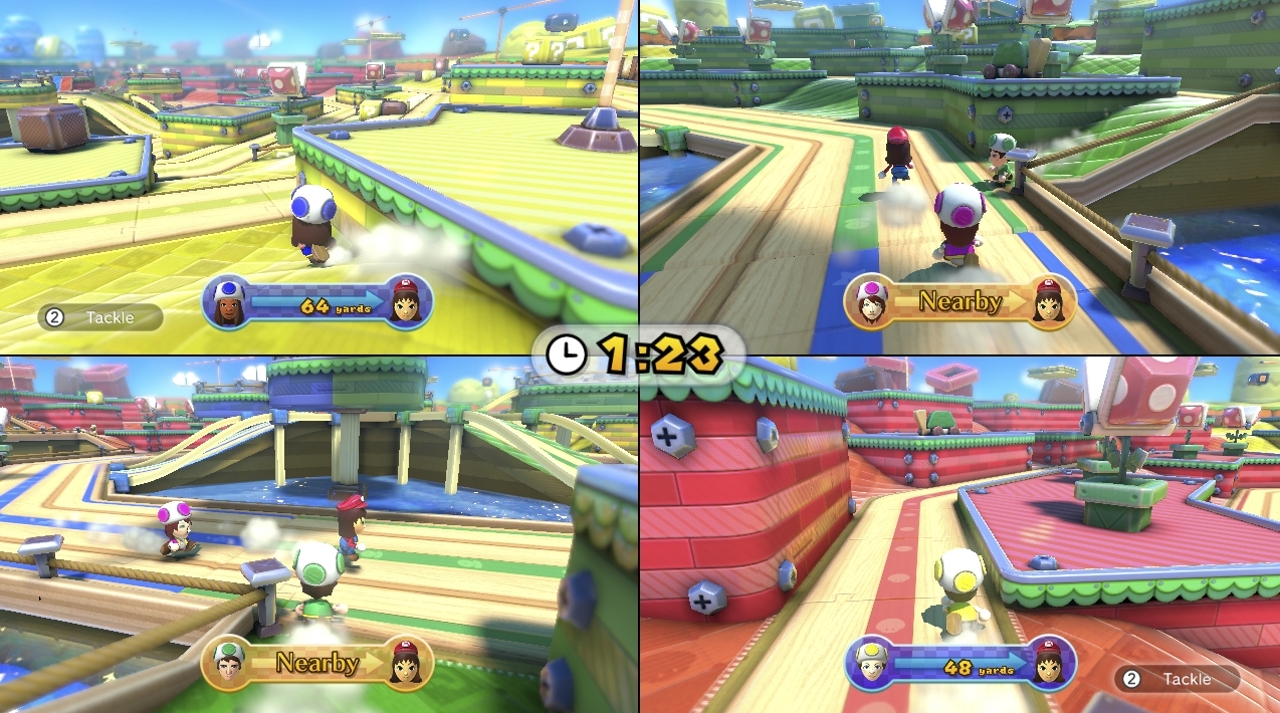
            The minigames are divided into co-op, competitive, and single player.  We’ll start with the competitive ones, as these are likely to be the ones that’ll get the family together to play.  They generally follow a similar concept: one side is trying to catch the other side.  Mario Chase is the simplest: the GamePad player is Mario, while the Wiimote players are Toads who have to tag Mario within the time limit.  The game’s simplicity doesn’t stop its franticness, as the Mario player can see everything, while the Toads have to communicate where they’ve seen Mario and judge the distance to figure out where Mario is.  Luigi’s Ghost Mansion bumps it up a bit, placing the GamePad player as a ghost who has to hunt down the Wiimote Luigis, who are armed with flashlights.  Extreme paranoia runs rampant here, as the Wiimote players have nothing but vibration to judge if the ghost is nearby, and the flashlight runs out of batteries after a while.  It’s tense, and the various levels manage to ramp up the difficulty appropriately.  Finally, there’s Animal Crossing: Sweet Day, where the Wiimote players are animals who have to run around and collect candy, while the GamePad player controls two guards simultaneously to track the animals down and tackle them.  Having to control both guards adds a level of complexity and tactics that’s a lot of fun, and the animals have to choose whether to risk getting in one place to get higher-value trees, along with the fact that eating more candy slows them down. 
All of the competitive games are fun, but there’s a strange sense of game balance.  For one, the games use bigger maps with 3-4 Wiimote players than with 1-2, but that generally turns out alright.  If it ever ends up as 1v1, though, the GamePad player can just forget about it.  Mario Chase adds Yoshi carts which hunt the Mario player down and stun them, giving the Toads an easy victory.  Sweet Day has places where the animal can deposit the candy, losing the main difficulty for them.  And Ghost Mansion adds a computer-controlled Monita player with an unlimited flashlight for each human player that isn’t there.  Not too bad with 3 Luigis, but with 1, it becomes a game of avoiding the Monitas.  If you’re going to play any of these games, you need at least 3 people, with 4 or 5 being ideal.
The co-op games are more intense than the competitive, ramping up the difficulty and seeming to aim more for the “core” audience.  Pikmin Adventure is the simplest, which has the GamePad player as Olimar and the Wiimote players as Pikmin.  You run around with a top-down view, fight enemies, and collect power-ups and nectar to level up.  It certainly doesn’t match the actual Pikmin, but it’s a fun pick-up-and-play experience, and easily the one you can share with the less experienced gamers.  The Legend of Zelda: Battle Quest is an on-rails shooter/slasher, where the GamePad uses a bow-and-arrow, while Wiimote players put their MotionPlus on for a sword and shield.  If you enjoyed the 1:1 sword motion in Skyward Sword, there’s plenty of it here, but simply going through wave after wave of enemies does get tedious after a while, especially with a shared life meter and some copy-pasted environments.  Along with the co-op quest, there’s also a bow-based time trial mode.  Metroid Blast is probably the closest thing in this collection to what could be a standalone game.  Not a retail game, but a $10 download, certainly.  The GamePad player takes control of Samus’ ship, while the Wiimote players are Samus herself, as you fight off enemies in an arena setting.  This is an honest third-person shooter, no on-rails, an actual experience.  It’s not much more than that, but it’s very fun and exciting.  This also comes with two competitive modes, a ground-vs-air mode and a free-for-all of the ground players.
And finally, we get to the biggest mixed bag of Nintendo Land: the single-player games.  Let’s start this off with one simple fact: with 6 multiplayer games which range from good to excellent, why they felt the need to stuff the rest of the collection with single-player games is beyond me.  Considering that the GamePad player has mainly been staring at the GamePad up until this point, it seems like this is where the gimmicks come out that use it and the TV together.  For instance, Yoshi’s Fruit Cart displays the fruit you have to pick up and the hazards you have to avoid on the TV, while you have to use landmarks on the background to draw a path with the GamePad.  This stands out as one of the weaker games in general, with its slow pace and generally tedious gameplay.  Balloon Trip Breeze fares better.  The TV shows a zoomed-out view, while the GamePad is zoomed-in on the player, as you swipe through spikes and enemies and float your way from island to island.  Having to look down on the GamePad to tap things adds some franticness, and in general, it’s just a fun little game.  Octopus Dance is a rhythm game that has you copy an instructor as you move your arms with the control sticks and tilt the GamePad.  I love rhythm games, and this is a solid one, that’s just difficult enough.  Captain Falcon’s Twister Race makes you tilt the GamePad to lead the Blue Falcon around obstacles.  It’s nice enough, although the difficulty ramps up fast and there’s little leeway in terms of the time.  Donkey Kong’s Crash Course is the single-player winner, as you tilt the GamePad to lead a weird contraption through obstacles.  It’s hair-pullingly difficult as you get used to what you’re doing, and yet you can’t help but say “One more try”.  And finally, there’s the single player loser, Takamaru’s Ninja Castle.  This definitely falls under “Did this really need the GamePad?”  You use it to slide ninja stars and defeat ninjas.  It’s like a rail shooter made unnecessarily difficult, as the sliding motion is tedious and will likely hurt your hand.  And ultimately, this could be done with a WiiMote.
Even with some fun ones in the single-player games, there’s still some big problems throughout.  For one, they’re way too short.  After you beat them, you gain extra levels for next time, but you have to go through the old content first and it never changes.  If there was a corridor of spikes in Balloon Trip, it’ll be there every time.  Next, properties just seem oddly used.  Yes, there’s shades of this in the other games, but it really comes out when you could’ve removed Donkey Kong’s name from Crash Course, and it wouldn’t have mattered that much.  Not to mention there’s some obscure properties here.  Ninja Castle is based on a game that was never even brought to America, and meanwhile, Star Fox and Pokemon get left out completely.

Overall, with the first-year drought of games coming to a close, Nintendo Land’s usefulness might be ending soon.  However, as a collection of a few fun games to play with family and friends, it’s worth getting, and it’s always nice to play with the GamePad before the big stuff comes along. 

Wednesday, August 7, 2013

Hellboy: The Midnight Circus


Written by Mike Mignola
Art by Duncan Fegredo

            I love Hellboy.  The many comic series that have built up the long-lasting story have stayed consistently entertaining, the movies have both been a good time, and the games…er, forget about those.  So I was excited to read the original graphic novel, Midnight Circus, but something here is missing.
            The story here focuses on a young Hellboy, who runs away from the BPRD and runs into the Midnight Circus, which is run by demons, and from there…well, things get fuzzy.  Don’t get me wrong, there have been some trippy moments in Hellboy stories in the past, but what exactly happens here is hard to determine.  The references to Pinocchio are interesting, but at the same time, Hellboy doesn’t really have a lot in common with Pinocchio.  And there’s foreshadowing that seems to carry little meaning besides being heavy foreshadowing.  It’s a story where things happen, and in a way, these things are interesting, but at the end of the day, I could not write you a logical synopsis.
            And yet, “things happen” is still a fascinating thing to happen to Hellboy.  If nothing else, knowing the pure weirdness he would encounter in the future, this seems like a spot where Hellboy is first thrust into what he’s going to spend the rest of his life fighting, and he reacts about how you’d expect a kid to react.  It’s interesting to see a different side of Hellboy, who isn’t yet all-powerful, but is still just a kid who has a tough destiny ahead.  The other real strength of this book is Fegredo’s art.  As always, I’m a little disappointed that Mignola does the cover when the interior is a different artist.  At the same time, Fegredo masterfully takes control of things.  In particular, there’s the art changes between the normal world and the Midnight Circus.  I had to check to make sure it wasn’t two different artists, and having it as just one is very impressive.

            So Midnight Circus isn’t quite a perfect story.  Even with the hard-to-understand story, there’s enjoyment to be had here.  But at the end of the day, there’s better Hellboy stories.